
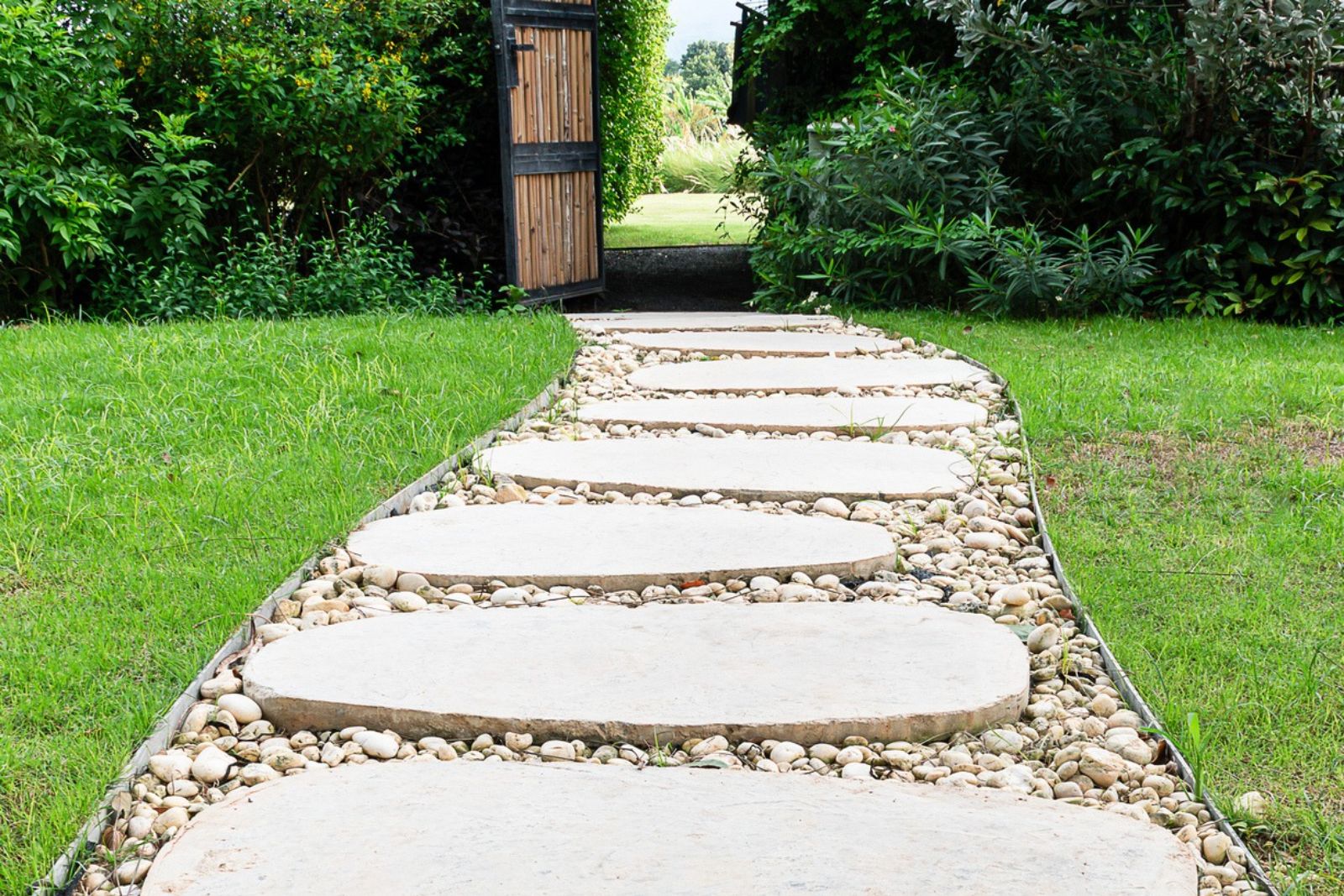
Every trip to the trash cans or the backyard gate means the same walk: a narrow strip along the house where the grass gave up years ago. After a rain it turns to mud, shoes come back caked, and everyone ends up hugging the wall to keep their feet clean.
This is not your fault. Side yards are hard places to grow anything. They’re often shaded by the house and the neighbors, they collect runoff, and they get walked on every day. Lisa of Garrison Street Design Studio describes hers as a north-facing slope with little sun, where weeds grew but grass didn’t and snowmelt turned it into a mud pit. The answer isn’t more grass seed. It’s a path. Here are 10 real side yards that got one.
Table of Contents
1. Tan stepping stones in brown pea gravel
Interior designer Sarah Gibson of Room for Tuesday finished her Utah side yard in three days. On the last one, she leveled the ground, laid weed barrier and paver base, set 16-inch tan patio stones and raked brown pea gravel around them. She notes the gravel hides any irregularities in the stones, and the area needs no irrigation or regular maintenance. During the same three days, she poured a concrete pad for a storage shed and added a 4-foot vinyl fence and gate.
2. A curving paver walk on a shady slope
For the mud-pit side yard, Garrison Street Design Studio first considered DIY stepping stones and gravel, then hired the crew that had built their patio because of the slope. In two days, they installed a paver walkway curving from the gate toward the driveway, a small brick retaining wall to make a level spot for the trash cans, and gray and white pebbles along the sides.
3. Gravel, stepping stones and a row of evergreens
Laura of the Garden Sanity blog had a lumpy, swampy side yard where visitors hugged the house to keep their shoes clean. After the grass came out, paver edging went in along curved lines, followed by sand-colored gravel and large stepping stones. Emerald Green arborvitae for privacy and Winter Gem boxwood against the house frame the path, and copper accent lamps were added the next spring. Laura says upkeep is minimal: occasional weeding and a spring pruning of the boxwoods.
4. Matching stones that finally go somewhere
Serena Appiah of Thrift Diving had a side walkway in Maryland that was overgrown with weeds and simply petered out. She extended it to the backyard patio with 12-by-24-inch stones matched to the existing ones, set on weed block and tamped paver sand, with white decorative rock in the gaps. The 12 stones cost about $221 including tax.
5. A gravel walk with a simple wood border
Chelsea Lipford Wolf of Checking In With Chelsea upgraded a stepping-stone path that runs from her driveway, alongside the garage, to the backyard gate. She removed the sod, framed the walkway with pressure-treated 1×4 boards on angled stakes, laid landscape fabric, reset her existing pavers and shoveled in gravel reused from the driveway. The boards were her only purchase.
6. Poured concrete slabs along the house
John and Sherry Petersik of Young House Love replaced a temporary walkway of small square pavers, laid over pine straw and dirt, with large poured-in-place concrete slabs along the side of the house. Three slabs sit on the same level between the gate and the kitchen porch, and a fourth steps down to the bedroom stairs.
7. Homemade concrete stepping stones with a hopscotch twist
Leanne of the Rave & Review blog had a narrow side yard that turned into a wet, muddy mess every time it rained. Her family cast stepping stones in plant boxes lined with plastic wrap, pressed in rocks, hopscotch numbers and the kids’ handprints, then set them on weed barrier and sand. Groundcovers planted between the stones are meant to spread and cut down on the mud.
8. Recycled concrete and decomposed granite
In Los Angeles, garden designer Shirley Bovshow turned an abandoned side yard, about 8 feet wide on average, into a 4-foot walkway flanked by beds about 2 feet deep. The stepping stones are broken, recycled concrete set about one stride apart, with drip irrigation tubing, crushed pea gravel and decomposed granite between them. Elfin thyme creeps between the stones and Festuca ‘Elijah Blue’ lines the edges.
9. Four inches of pea gravel on a hillside strip
Liz of A Mothership Down had a sloped, rocky side yard full of weeds and roots that opened onto the neighbor’s driveway. After leveling it and adding a small retaining wall, privacy fencing and an arbor, she spread pea gravel about 4 inches deep over a fabric liner. She chose it because it was cheaper than stone or decking and quick to install, and reports it stayed weed-free a year later.
10. A curving path through a planted side garden
Garden writer Rebecca Sweet described Lisa Mitchell’s side yard as one of the dreariest she had ever seen, covered in debris from a former salvage yard that took three dumpsters to clear. Mitchell replaced a narrow garden strip with a wider, curving pathway along the side of the house, lined with jasmine, hydrangeas, Japanese maples and Hakone grass, and finished it with a vine-covered arbor.
Before you dig
Call 811 before digging so utility lines can be marked; Laura of Garden Sanity notes that even after her utilities were marked, the marks turned out to be wrong, so dig carefully. Leave room around air conditioners and other equipment for airflow and service, as Room for Tuesday did when screening its unit.
A slope or poor drainage may call for a pro, as it did for Garrison Street Design Studio. Renters and homeowners with an HOA should check the rules before adding fences or permanent paving. For more path and step ideas, these stone garden steps include stepping stones set in gravel. Clear the strip, pick one surface and give every step a solid landing. That’s the trick.
WHAT DO YOU THINK?