
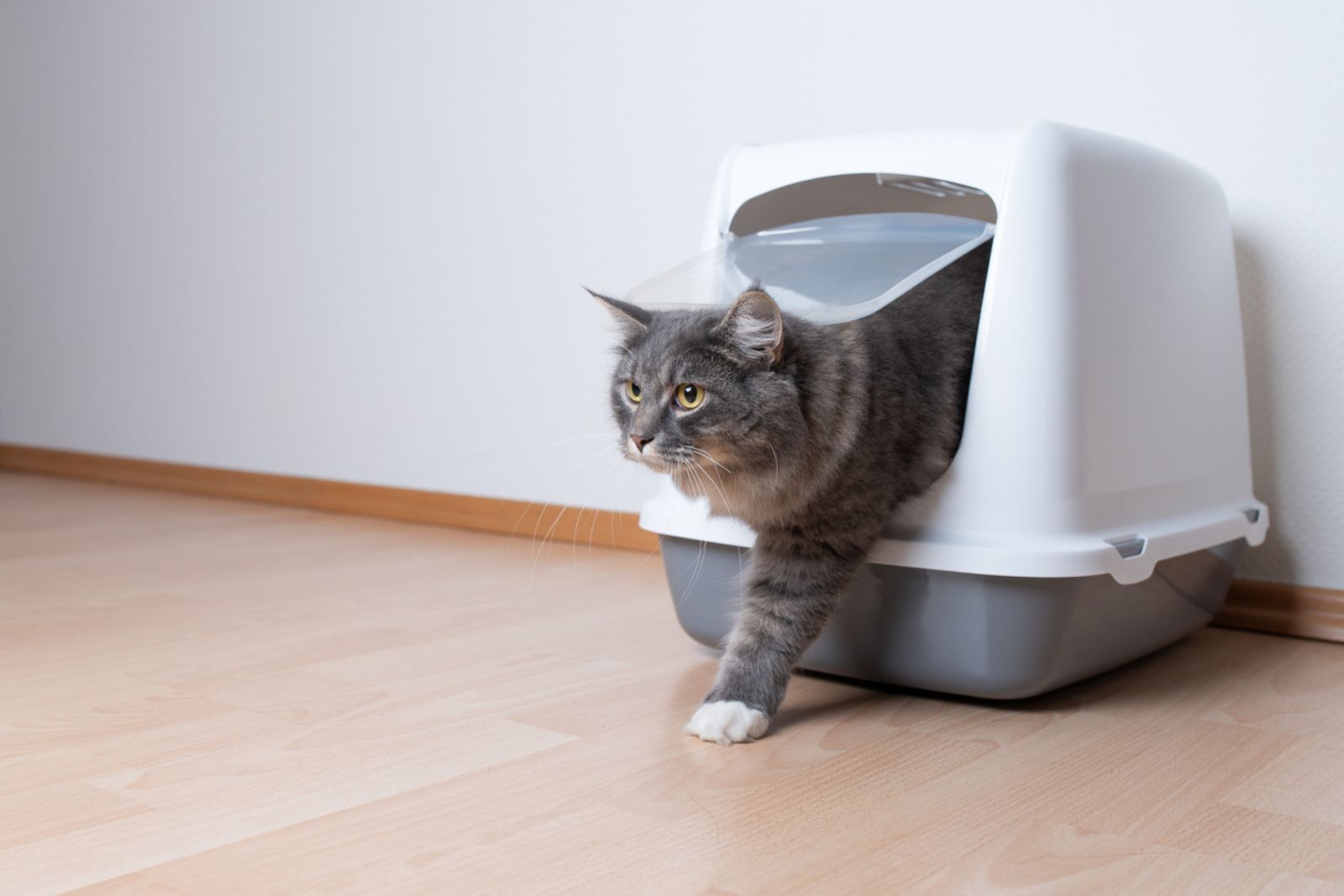
Guests are coming, and the first thing anyone sees from the couch is a plastic tray in the corner, a scatter of litter on the floor around it and the scoop leaning against the wall. You’ve moved it to the bathroom, then the hallway, then back again. Every spot either looks bad or your cat refuses to use it.
This is not your fault. A litter box is one of the hardest things in a home to place, because it has to work for two very different judges. You want it out of sight. Your cat wants it quiet, easy to reach and easy to leave. Veterinary guidance from the American Animal Hospital Association and the American Association of Feline Practitioners calls for boxes in multiple quiet locations that are convenient for the cat and provide an escape route if necessary. The good news: plenty of real homes have managed both. Here are 10 of them, followed by the vet rule to check before you close the doors.
Table of Contents
1. A storage bench along the living room wall
A reader of IKEA Hackers who posts as jlprittenhouse turned an IKEA BESTÅ storage combination into a cushioned bench along the back wall of the living room. A jigsaw cut one opening on each side, about 11 inches wide and 6 inches tall, finished with thin poplar trim. With five cats in the house, the bench holds two boxes, and four more sit in the basement laundry room. The build came to about $172, or $223 with the cushions.
2. A grid-top table with a door in the lid
For her hallway, Béatrice T. used an IKEA HOL storage table, a slatted wooden box, and cut a top-entry opening of about 18 by 18 centimeters in the back corner of the lid. A high-sided plastic storage box sits inside as the litter box. She says the open grid keeps the whole thing well ventilated, and that a good clumping clay litter keeps it from smelling.
3. A tall cabinet with its own air filter
In a one-bedroom apartment where a large top-entry box didn’t fit in the small bathroom, David Perry built an enclosure from IKEA EFFEKTIV cabinet parts. The opening, cut with a jigsaw, lines up with the lid of the box. A small HEPA air filter sits on a shelf above, with its cord running through a second hole. He says the filter helps with odors, though he admits it isn’t a miracle.
4. A bench with an exit on both sides
Jordan converted an IKEA STUVA bench, since renamed SMÅSTAD, by tracing and cutting a hole in the side and using a large plastic storage tote as the box. A later update added access holes on both sides so a cat can always get out the other way, and considered small ventilation holes too. That second door is a small detail that lines up with the escape-route advice vets give.
5. A metal locker cabinet with a cat flap
Andrea, who writes the Salty Canary blog, got tired of finding litter all over her bathroom floor. She installed a cat door in the side of an IKEA double locker cabinet, then checked that no sharp metal edges were left exposed. Her advice for keeping it fresh is simple: scoop every day and clean the cabinet regularly.
6. A white cabinet between the living room and the nursery
Danae of The Homebody House fit an IKEA BRUSALI cabinet into a narrow strip of wall in her sunroom, between the living room and the nursery. She cut an opening in one side panel for an extra-large cat door and bought an extra-large open litter pan sized to the inside of the cabinet. The cat food, trash bags and scoop live in there too. From the outside, she says, no one would know the litter box is inside.
7. Two cabinets tucked under the stairs
Stefania sized two IKEA BESTÅ units to fit under the stairs in her living room. She cut three holes in the sides to create a two-room enclosure, and made the litter tray itself from a sheet of corrugated plastic. Under-stair space is often wasted, and a low cabinet turns it into a spot with doors you can close.
8. A mudroom wall of base cabinets with an exhaust fan
When Don and Michele Smollett built a new home with a large mudroom, they set three IKEA SEKTION base cabinets along the wall, each with a low MAXIMERA drawer holding a litter box. A doorway cut into the wall leads into the cabinets, and openings between them form a walkway. At the end, a motion-activated exhaust fan vents through the wall to the outside.
9. A plywood cabinet with a cushion on top
With an unfinished basement, Jeni Baker of In Color Order needed a spot upstairs for her cat, Miss Dusty Kitty. She built a simple cabinet from 3/4-inch plywood, finished it with shellac and added a cushion on top. It sits near a window that looks out on the driveway. The kitty door is 9 inches tall and 8 inches wide, a little bigger than needed, she says, to make sure her cat would use it.
10. An old kitchen island with curtains for a door
Scott of the blog Saws on Skates rebuilt an old butcher block kitchen island into a litter cabinet for his friend Linda, who chose to keep it in her kitchen near a window and the trash can. Three drawers on top hold supplies, two doors below hide the box, and the cats walk in through a side opening covered with small fabric curtains.
If you’re planning a bigger refresh, many of these apartment remodel ideas lean on built-in storage, which is exactly where a hidden litter cabinet can live.
The vet rule to check before you box it in
The first rule is about numbers. Dr. Audrey Cook, a professor at the Texas A&M School of Veterinary Medicine and Biomedical Sciences, says, “The house should have one box for each cat plus one extra, so two for one cat, three for two cats, and so on.” Hiding one box doesn’t change that count.
Before you build, check these points:
- Size: the Feline Veterinary Medical Association says a box should be 1.5 times the length of the cat from the nose to the base of the tail. Measure the inside of the cabinet before you buy.
- Lids: Cook notes that some cats do not like to be in a covered box, as they can’t survey their surroundings. A cabinet works like a lid.
- Closets and small rooms: the same association warns against spots where a cat could be trapped, such as a box in a closet or small room. Two exits, as in the bench above, help.
- Noise: sudden noises from furnaces or other loud appliances can startle a cat away from the box.
- Cleaning: scoop at least once a day. Out of sight is easy to forget.
If your cat starts going outside the box after you enclose it, take the doors off or go back to the old spot, and talk to your veterinarian. Renters should check their lease before cutting holes in walls, and venting a fan outside is a job for a pro.
Hide the box, but give your cat a big enough tray, a way out and one more box than you have cats. That’s the trick.
WHAT DO YOU THINK?